
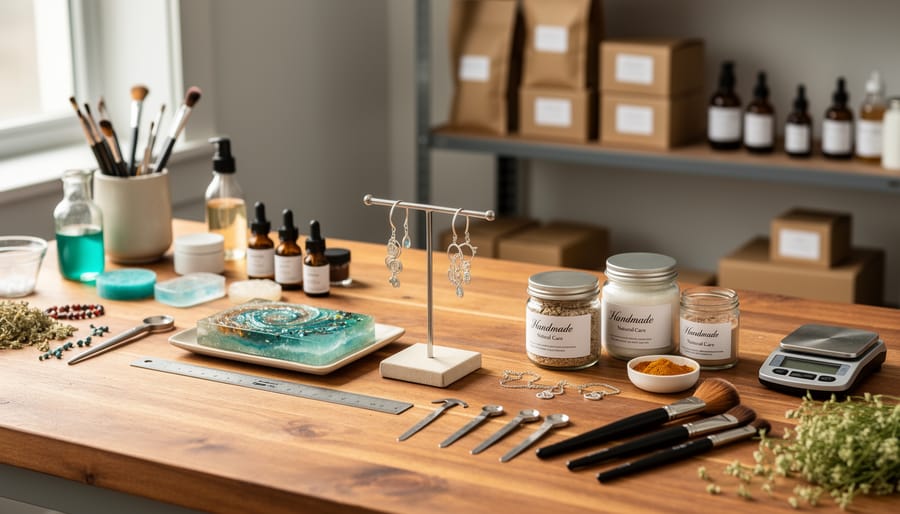
A profitable craft business generates consistent revenue that exceeds material, labour, and operational costs by a meaningful margin, typically yielding net profit margins between 30% and 65% depending on the craft category and business model. For Canadian entrepreneurs considering the craft market, identifying which specific craft business offers the strongest income potential can mean the difference between a fulfilling side income and a sustainable full-time career.
The most profitable craft businesses share three traits: low material costs relative to selling price, efficient production methods that allow scaling without sacrificing quality, and strong market demand that supports premium pricing. Handmade jewellery, personalized home décor, and specialty bath and body products consistently rank among the top earners, but profitability varies based on your skills, target market, and willingness to refine production systems.
What makes this decision challenging is that “most profitable” doesn’t mean the same thing for everyone. A woodworker in Alberta might find custom furniture highly lucrative due to local demand and workshop space, while a crafter in downtown Toronto could achieve better margins with compact, shippable items like resin art or digital printables that eliminate inventory overhead.
This guide breaks down the craft categories with proven profit potential in the Canadian market, explaining how each business model works operationally, what realistic income looks like across different scales, and which factors determine success. You’ll see comparison data from actual craft entrepreneurs, understand the practical applications of those profits, and get clear direction on choosing the right craft path for your circumstances. Whether you’re ready to launch a craft business or exploring options, these insights will help you invest your time and money wisely.
Defining Profitability in Craft Businesses
Profitability in craft businesses goes beyond simply making sales. A truly profitable craft venture generates consistent revenue that exceeds all costs while providing sustainable income for the owner. Understanding what separates a profitable craft business from one that barely breaks even requires examining several interconnected factors.
The most profitable craft businesses share common characteristics that set them apart. They maintain healthy profit margins, typically 50% or higher after accounting for materials and direct costs. They create products that command premium prices relative to production time. They operate with manageable overhead that doesn’t consume most of their revenue. Most importantly, they build systems that allow growth without proportional increases in workload.
- Profit Margin
- The percentage of revenue remaining after deducting all direct and indirect costs. Craft businesses should target margins of 50-70% to remain viable and support sustainable growth.
- Revenue Streams
- The different ways a craft business generates income, such as direct sales, wholesale orders, custom commissions, and passive income from digital products. Diversified streams create stability and reduce risk.
- Overhead Costs
- Fixed expenses that continue regardless of sales volume, including studio rent, subscription services, equipment maintenance, and insurance. Lower overhead increases profitability at any revenue level.
- Scalability
- The ability to increase production and sales without proportionally increasing time investment or costs. Scalable crafts can grow revenue faster than expenses grow.
- Break-Even Point
- The sales volume at which total revenue equals total costs. Profitable craft businesses reach this threshold quickly and maintain consistent sales above it.
When evaluating craft business opportunities, consider how quickly you can produce each item, what materials cost relative to selling price, and whether you can systematize production. A craft that takes eight hours to make but sells for thirty dollars will never be as profitable as one that takes two hours and sells for forty dollars, even if the first seems more impressive.
The most profitable options balance production efficiency with strong market demand and pricing power. They allow you to create consistent inventory without burning out, reach customers through multiple channels, and adjust to market changes without complete reinvention.
How Profitable Craft Businesses Work

The Production and Pricing Equation
Profitable craft businesses master a fundamental equation: the sale price must exceed production costs by enough to make your time valuable. Your material costs are just the starting point. A bracelet might use $3 in beads and wire, but calculating your true cost means factoring in packaging, shipping supplies, platform fees, and the two hours you spent designing and assembling it.
Successful makers track their hourly rate ruthlessly. If you spend four hours making candles that sell for $60 total but cost $20 in materials, you’re earning $10 per hour before overhead. That’s not profitable. The fix? Streamline production through batching similar items, raise prices to reflect your skill level, or choose products with better time-to-value ratios.
Premium pricing works when you can justify it. Hand-carved wooden signs command $150 because buyers see the craftsmanship and uniqueness. Mass-produced items can’t compete on price with factories, so profitable craft businesses compete on customization, quality, or story.
The math changes as you scale. Buying materials in bulk drops per-unit costs. Perfecting your process cuts production time. A jewelry maker who initially spent 90 minutes per piece might reduce that to 30 minutes through practice and better tools, tripling effective hourly earnings without touching the price.
Sales Channels and Market Reach
Where you sell matters as much as what you sell. A stunning handmade necklace priced at $85 might sit unsold at a local craft fair but fly off the digital shelf on Etsy, where your ideal customer actively searches for exactly that style.
Online marketplaces like Etsy, Amazon Handmade, and Shopify give craft businesses immediate access to millions of buyers without the overhead of physical retail. These platforms charge listing or transaction fees (typically 5-15% of sales), but they handle payment processing and provide built-in traffic. The trade-off: you’re competing with thousands of other sellers, making product photography, SEO, and digital marketing tools essential for standing out.
Wholesale partnerships with boutiques and retailers offer volume sales at lower per-unit prices. You might sell candles for $12 wholesale that retail for $24, accepting a smaller margin in exchange for bulk orders and predictable revenue. This channel works best once you’ve streamlined production and can handle larger order quantities.
Direct sales through your own website or at markets keep 100% of your revenue but require more marketing effort. You control the customer experience and build lasting relationships, but you’re responsible for driving every sale yourself. Most profitable craft businesses use a mix of channels, starting with one platform to validate demand before expanding their reach.
Types of High-Profit Craft Businesses
Handmade Jewelry and Accessories
Handmade jewelry consistently ranks among the most profitable craft businesses because it combines low material costs with exceptional pricing flexibility. A silver ring that costs $8 in materials can sell for $45, $75, while polymer clay earrings with $2 in supplies often retail for $25, $35. This dramatic markup potential sets jewelry apart from other crafts where material costs eat up larger portions of revenue.
The market demand remains remarkably strong across all demographics and price points. Customers regularly purchase jewelry as gifts, for special occasions, and as affordable self-rewards, creating repeat buying patterns that few other craft categories match. The personal nature of jewelry, how it expresses identity and marks meaningful moments, makes customers less price-sensitive than they are with functional items.
Jewelry businesses scale efficiently without major equipment investments. You can start with basic tools for under $200 and expand your materials inventory gradually as sales grow. This positions jewelry among the most accessible profitable home ideas for Canadian entrepreneurs. The lightweight, compact nature of jewelry also keeps shipping costs minimal, which protects your margins when selling online and makes it easier to compete nationally without the overhead of local retail space.

Custom Woodworking and Furniture
Custom woodworking stands out for its exceptional profit potential because customers willingly pay premium prices for handcrafted furniture and home pieces they can’t find in retail stores. A custom dining table that costs $300 in materials and twenty hours of skilled labour can sell for $2,500 to $4,000, creating profit margins of 70% or higher once you factor in your time as a craftsperson building a business.
The profitability comes from several factors: wood products are tangible investments that buyers view as long-term purchases, customization commands higher prices than mass-produced alternatives, and skilled woodworkers remain relatively scarce compared to demand. Live-edge tables, built-in shelving, and personalized cutting boards consistently generate strong returns.
Canadian woodworkers benefit from access to quality domestic lumber and a market that values craftsmanship. Starting requires significant tool investment ($2,000-$5,000 minimum), but once established, material costs stay predictable while your pricing grows with your reputation and skill level.
Bath, Beauty, and Skincare Products
Bath and beauty products stand out because customers need to restock them. A candle burns out, a bar of soap disappears, lotion runs empty, each sale creates an opening for the next. Unlike one-time purchase crafts, consumables build a customer base that returns every few months. According to repeat purchase benchmarks skincare buyers typically reorder within 60 to 90 days, turning a $20 first order into $200 in annual revenue per customer.
The profit margins are equally attractive. Handmade soap costs $2 to $4 to produce and sells for $8 to $12. Lip balms run under $1 each in materials but retail for $5 or more. These products also lend themselves to recurring payments through subscription boxes, customers sign up for monthly deliveries of their favourite body butter or face serum, creating predictable cash flow. Production scales well too: you can make 50 bars of soap in the same time it takes to craft one piece of jewelry, maximizing your hourly return.
Digital Products and Printables
Digital products and printables represent one of the most profitable craft categories because you create them once and sell them infinitely without manufacturing costs. Items like wall art, planners, stickers, party decorations, and templates require only design time upfront, no materials, shipping, or inventory storage.
Profit margins often exceed 90% since your only ongoing costs are platform fees (typically 5-10%). A single design can generate passive income for years through platforms like Etsy, Shopify, or your own website. Successful Canadian sellers report earning $2,000-$8,000 monthly once they’ve built a catalog of 50-100 designs. The scalability is unmatched: whether you sell 10 or 10,000 downloads, your workload stays the same.
Candles and Home Fragrance
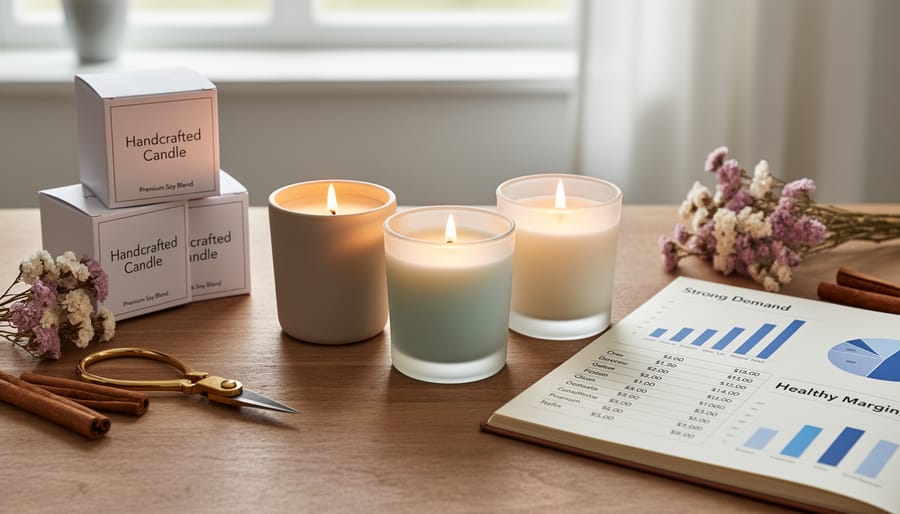
Candle-making offers one of the best profit margins in the craft world because raw materials, wax, wicks, fragrance oils, and containers, cost remarkably little per unit while finished candles sell at premium prices. A candle that costs $3-5 to produce typically retails for $15-30, delivering margins of 60-80%. The market remains strong year-round with seasonal peaks, and consumers treat candles as both functional purchases and affordable luxuries they buy repeatedly. Production scales easily from kitchen-table batches to larger operations, and the lightweight nature of candles keeps shipping costs manageable for online sales. Custom scent blends and aesthetic packaging let makers differentiate their products without significantly increasing production expenses.
Personalized and Custom Items
Customization transforms standard craft products into premium offerings that justify higher prices. When customers can add names, dates, or specific design elements to an item, they perceive significantly more value than mass-produced alternatives. This applies across nearly every craft category, from engraved cutting boards to monogrammed leather goods to custom pet portraits.
The profitability advantage comes from both higher selling prices and emotional purchasing decisions. Personalized gifts command 40-60% price premiums over similar non-customized items because buyers aren’t just purchasing an object, they’re buying a meaningful connection. A generic wooden sign might sell for $25, while the same sign with a family name and established date can fetch $50-$75.
Production costs remain relatively stable whether you’re making personalized or standard items, making that price difference almost pure profit margin.
Uses and Applications for Craft Business Profits
Once your craft business generates consistent profits, how you deploy that money determines whether you build a sustainable venture or simply fund a hobby. Most successful craft entrepreneurs follow a deliberate reinvestment strategy, directing profits back into the business rather than withdrawing every dollar as personal income, especially during the first year or two.
Consider where craft business owners typically allocate their profits:
- Scaling production capacity with better equipment or larger workspaces
- Hiring part-time help for production, packaging, or administrative tasks
- Expanding product lines to reach new customer segments
- Investing in marketing channels like social media ads or brand strategy tips that increase visibility
- Building inventory to meet seasonal demand spikes
- Saving for specialized equipment that reduces production time
- Creating passive income streams through digital products or licensing
The split between reinvestment and personal income depends on your goals. Growth-focused entrepreneurs might reinvest 60-80% of profits during the first two years, accelerating their path to a full-time income. Others adopt a lifestyle approach, taking a steady 40-50% as personal earnings while growing slowly. A candle maker in Halifax, for example, might keep half her $3,000 monthly profit for living expenses and use the rest to expand her product line from ten scents to twenty.
Smart reinvestment creates compounding returns. Buying a heat press for $800 might cut your production time per custom shirt from twenty minutes to five, letting you quadruple output without quadrupling hours worked. That efficiency gain unlocks wholesale opportunities previously impossible at your old production speed. The key is choosing investments that directly increase either your profit per item or your total production capacity, not just purchasing tools that feel professional but don’t move the needle on revenue.
Key Factors That Determine Craft Business Profitability
Choosing a profitable craft isn’t enough, execution determines whether your business thrives or struggles. Several critical factors separate makers who build sustainable income from those who can’t cover their costs.
Niche Selection and Market Demand
The most successful craft businesses operate in niches with strong demand but manageable competition. Instead of selling generic items, profitable makers identify specific customer problems or preferences. A jewelry maker targeting nurses with functional, durable accessories will outperform one selling generic bracelets. Research your market before committing: check search volumes on Etsy, analyze competitor pricing, and validate that customers actually pay for what you plan to make.
Strategic Pricing
Many craft businesses fail because makers underprice their work. Calculate your true hourly rate by adding material costs, overhead, and your desired wage, then multiply by three for wholesale or five for retail. A candle that costs $4 in materials and takes 30 minutes to make should sell for $20-25 retail if you’re targeting $30 per hour. Don’t compete on price, compete on quality, uniqueness, or service.
Production Efficiency
Profitable makers streamline their process. Batch production cuts time dramatically: making ten items simultaneously instead of one at a time can reduce per-unit time by 60%. Create templates, jigs, and systems that eliminate repetitive decisions. Track how long each product takes and regularly identify bottlenecks. The difference between earning $15 per hour and $50 often lies in production speed, not pricing.
Effective Marketing
Craft businesses that rely solely on marketplace algorithms struggle. Build your own audience through email lists, Instagram, or Pinterest where you control the relationship. Profitable makers invest 20-30% of their time in marketing, showcasing products, sharing behind-the-scenes content, and engaging with customers. Focus on one or two channels where your target customers spend time rather than spreading thin across every platform.
Customer Retention
Acquiring new customers costs five times more than selling to existing ones. The most profitable craft businesses build repeat customer relationships through excellent service, consumable products, or seasonal collections. A bath products maker with 200 customers who reorder quarterly generates more reliable income than one constantly chasing new buyers.
Real Canadian Success Stories
Marissa Chen started Blue Spruce Candle Co. in her Edmonton apartment in 2023, mixing small batches of soy candles inspired by Alberta landscapes. Within 18 months, she built a $180,000-a-year business by focusing on wholesale partnerships with boutique gift shops across Western Canada. Her strategy centred on creating signature scent profiles that retailers couldn’t source elsewhere, allowing her to maintain 60% profit margins while producing just four core products. She invests heavily in automation tools that handle inventory tracking and wholesale order management, freeing her time to develop new fragrances and nurture retailer relationships.
Toronto-based woodworker James Okafor turned his custom cutting board hobby into Forest & Grain in 2022, now generating $240,000 annually through made-to-order charcuterie boards and serving pieces. His profitability stems from premium hardwood selection and personalized engraving services that justify prices between $150 and $450 per piece. James accepted early that he couldn’t compete on volume, so he positioned his work as heirloom-quality pieces for milestone celebrations. He builds two months of orders at a time, then closes his shop for production periods, which maintains exclusivity while preventing burnout. His Instagram showcasing finished pieces in real customer homes drives 70% of new orders without paid advertising.
Halifax jewelry maker Sophie Leblanc launched Tidal Metals after a corporate layoff in 2024, creating coastal-inspired silver jewelry. She reached $95,000 in revenue within her first year by combining online sales through her Shopify store with seasonal appearances at high-end craft markets in Atlantic Canada. Sophie keeps her material costs under 20% by purchasing silver in bulk and designing pieces that maximize metal usage while minimizing waste. Her email list of 3,200 subscribers generates consistent sales through monthly limited releases that create urgency without requiring constant production.
Common Questions About Profitable Craft Businesses
Starting a profitable craft business raises practical questions about costs, timelines, and realistic income potential. Here are answers to the most common concerns from Canadian entrepreneurs considering this path.
How much can you realistically make from a craft business?
Craft business income varies widely based on product type, pricing strategy, and time invested. Part-time craft businesses typically generate $500 to $3,000 monthly, while full-time operations with refined systems can reach $5,000 to $15,000 monthly or more. Your earnings depend on production capacity, profit margins, and marketing effectiveness rather than the craft type alone.
What craft business has the lowest startup cost?
Digital printables require the lowest investment, often under $100 for design software and an Etsy shop. Candle-making and soap-making also start around $200 to $300 for basic supplies and molds. These options let you test profitability before committing significant capital.
How long does it take for a craft business to become profitable?
Most craft businesses reach profitability within three to six months if you price correctly and maintain consistent marketing efforts. The timeline shortens when you start with a clear niche and existing audience, but extends if you’re building brand awareness from scratch or underpricing your work.
Do I need business licenses to sell crafts in Canada?
Requirements vary by province and municipality, but most craft businesses need at least a business license from their city or town. If you’re selling consumables like food, candles, or skincare products, additional permits and liability insurance become necessary to operate legally and protect yourself.
The path from hobby crafter to profitable business owner involves answering these questions honestly for your situation. Startup costs matter less than your ability to price profitably and reach customers who value your work. Many successful craft entrepreneurs begin part-time, using their first sales to fund inventory and tools rather than investing heavily upfront.
Scaling presents different challenges than starting. You’ll eventually face decisions about hiring help, automating production, or limiting custom orders to maintain margins. The craft businesses that replace full-time income typically do so by either creating systems that allow higher volume without proportional time increases, or by positioning themselves at premium price points where fewer sales generate substantial revenue.
how it works
Building a profitable craft business follows a repeatable pattern regardless of what you make. You start by identifying a craft category where your skills intersect with market demand, something people actively buy and that you can produce efficiently. The goal is finding products with material costs below 30% of your selling price.
Next comes product development. You create samples, test pricing with real customers, and refine your offerings based on feedback. This phase reveals whether your time investment makes financial sense. A profitable craft business means you earn at least $25-$30 per hour after covering materials.
Once your product works, you establish consistent production systems. This might mean batching similar items together, creating templates for custom work, or streamlining your assembly process. Efficiency directly impacts profit.
Finally, you build sales channels, typically starting with online marketplaces like Etsy or a Shopify store, then expanding to craft fairs, wholesale accounts, or subscription models as revenue grows. The most profitable craft businesses diversify their sales channels within 12-18 months to reduce platform dependency and capture different customer segments.
Types or components
The components that determine craft business profitability work together as an interconnected system rather than isolated elements.
Market demand forms the foundation, profitable crafts solve specific problems or fulfill clear desires for defined customer segments. Without genuine demand, even the most beautifully executed craft struggles to generate consistent sales.
Production efficiency directly impacts your bottom line. The time required to create each item, your skill level, and your workflow systems determine how many units you can produce and at what true cost.
Pricing structure balances what customers will pay against your costs and desired profit margin. Profitable craft businesses command prices that reflect their value proposition, not just materials and time.
Sales infrastructure encompasses your chosen platforms, payment systems, shipping methods, and customer service approach. These operational elements either support or limit your ability to scale profitably.
Marketing capability drives customer acquisition and retention. Your ability to reach the right audience, communicate your value, and convert interest into sales determines revenue potential.
When these components align effectively, they create the conditions for sustainable profitability regardless of which specific craft category you pursue.
The most profitable craft business isn’t a one-size-fits-all answer, it’s the one that aligns your unique skills with genuine market demand and consistent execution. While jewelry, woodworking, and bath products often top profitability lists, your success depends more on how well you understand your margins, price strategically, and connect with customers than on simply choosing a trending category.
Start where you’re already competent. If you can create quality products efficiently, you’re halfway to profitability. The other half comes from mastering the business fundamentals: calculating your true costs, pricing for sustainable profit, choosing sales channels that work for your lifestyle, and marketing to the right audience. Many Canadian craft entrepreneurs stumble not because they picked the “wrong” craft, but because they underpriced their work or spread themselves too thin across too many products.
The craft businesses that thrive in 2026 share common traits: focused product lines, clear understanding of their ideal customer, efficient production systems, and pricing that respects both their time and expertise. They’ve moved beyond hobby thinking into business thinking, tracking what sells, what’s profitable, and what drains resources without returns.
Craft-based business opportunities offer Canadian entrepreneurs a real path to income, whether you’re building a side revenue stream or a full-time venture. The key is treating profitability as a skill you develop, not an accident you hope for. Choose your craft, master the numbers, and commit to continuous improvement, that’s the formula that turns creative work into sustainable profit.
You may also like
-
How to Do Digital Marketing for Your Small Business: A Step-by-Step Guide to Getting Started
-
How to Market Your Hemp CBD Business in Canada: Step-by-Step Strategy for 2026
-
How to Use Zapier for Small Business: Automate Your Marketing in 7 Steps
-
Innovation in Small Business: How Digital Tools Transform Your Operations
-
Revamp Your Small Business: Digital Transformation Success in Canada